
Rebuilding our communities
Share this story
Following the 15th anniversary of the 22 February earthquake, we’re looking at different Council aspects of the rebuild, and how far we’ve come. Next up, community hubs and housing facilities.
The years post-quake saw the rebuild and reopening of many community hubs and facilities across Christchurch and Banks Peninsula. These centres enable a place for community connectivity – to gather, provide social support, hold activities, meetings and celebrations.
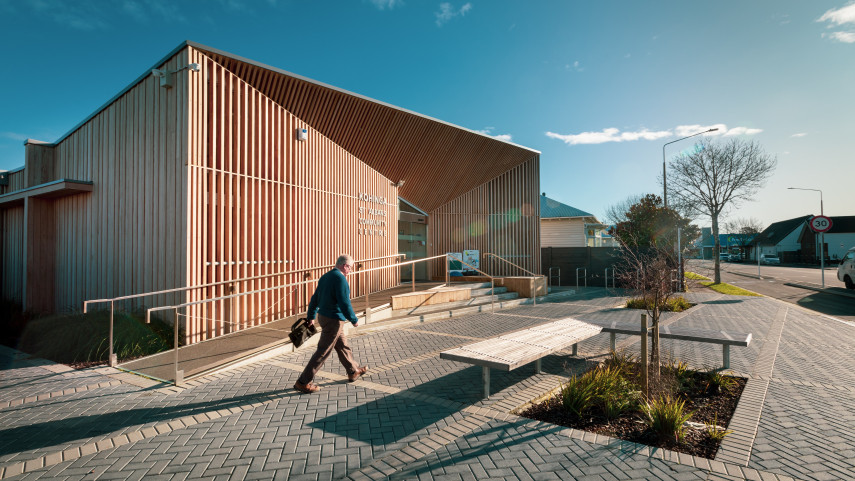
The Aranui Wainoni Community Centre opened in 2016 – the first centre to be fully rebuilt following the quakes. Constructed on the site of the demolished Aranui Wainoni Family Centre on Hampshire Street, it has sports facilities, meeting and office spaces and indoor and outdoor stages.

The Aranui Wainoni Community Centre opened in 2016
The busy suburb of Riccarton celebrated the opening of its new $4.5 million community hub on Clarence Street in late 2019, which replaced the quake damaged building next door. Rārākau: Riccarton Centre has community spaces, customer service areas, and acts as a meeting venue for the Waipuna Halswell-Hornby-Riccarton Community Board.
The $2.7 million Kohinga St Albans Community Centre was officially opened in April 2021, marking the first permanent facility on its Colombo Street site for a decade.
The floor plan for the 400m2 building was agreed on by a working group made up of Community Board members and representatives from groups including the St Albans Residents’ Association, Edgeware Business Association and St Albans School.
As communities grow around these facilities, they become prominent landmarks within each suburb.
Gaiety Hall, the popular heritage building, function centre and gathering place for the Akaroa community, was meticulously repaired and strengthened post-quake before reopening in 2016.

Gaiety Hall was meticulously repaired and strengthened post-quake
Built in 1878-9 and known as the ‘ornament’ of Akaroa, the heritage building served as the former hall of Akaroa’s Oddfellows’ Lodge, a gathering place for the community, and Akaroa’s cinema for much of the twentieth century.
Halswell Quarry Park and the historic buildings within were restored post-quake as a passive recreation reserve, wildlife habitat and educational resource. The quarry operated between 1861 and 1990, before becoming the 60ha Halswell Quarry Park which now has mountain biking tracks, walks, picnic spots and a dog exercise area.
The rock faces of the quarry were retained post-quake, and over 250,000 trees and shrubs were put in the ground. The Park’s historic buildings were repaired and strengthened, including the well-known Old Stone House.

Halswell Quarry Park and the historic buildings within were restored post-quake as a passive recreation reserve
Council-owned community (social) housing underwent a major programme of repairs and rebuilds following the Canterbury earthquakes. Around 2200 units, along with associated infrastructure such as paths, driveways and three‑waters services, were repaired or replaced, with a total investment of $70–$80 million.
A key part of the post‑quake response was the Council’s decision to establish the Ōtautahi Community Housing Trust (OCHT) to lease and manage its social housing portfolio. This allowed access to the Government’s Income-Related Rent Subsidy, supporting the long‑term replacement of older housing stock.
The Council has a target, in conjunction with its housing partners, to replace all 366 units that were demolished after the earthquakes by 2031. Since 2019, OCHT has built 315 new homes on former Council land, reaching the replacement target when the Willard Street development opened in 2023.
What’s still to come?
Next up is the Shirley Community Facility, with plans approved by the local Community Board in December 2025.
The former centre at 10 Shirley Road was home to a number of organisations and programmes that contributed towards community connectivity. The new plans aim to make sure the reserve continues to be a place where the community can come together.
Popular news