
Timely reason to revisit Lyttelton landmark
2 Nov 2018
Share this story
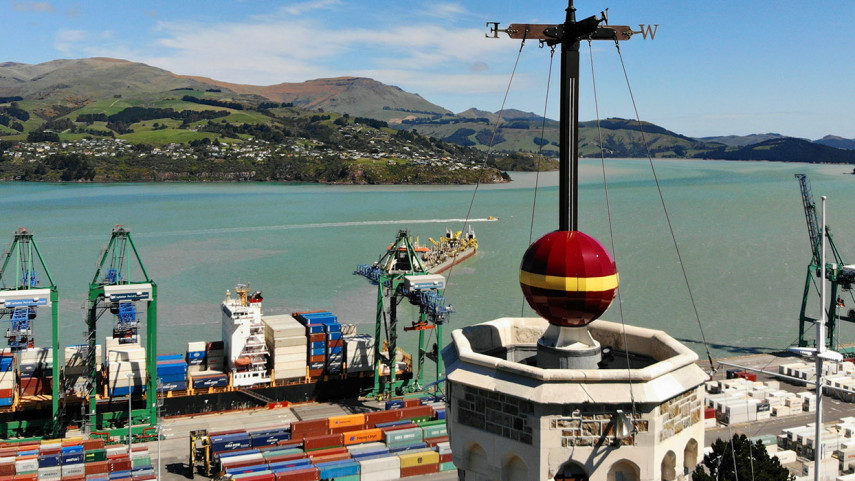
A $3 million restoration project in Lyttelton signals the region’s resurgence as the timeball officially drops back into place in the port town at 1pm today.
The seven-year project restores one of the harbour’s most distinctive features to a new stone tower overlooking the town.
From 1876 to 1934, the timeball dropped from the original tower mast, signalling the time to ships in Lyttelton Harbour.
From their decks, sailors would wait for the signal from the hill at 1pm daily to help correct ships' chronometers and enable accurate navigation.
Despite being overtaken by technology, the timeball continued to drop daily, operating for 135 years before being wrecked in the 2010-11 earthquakes. Today, it resumes its regular role.
Heritage New Zealand has overseen the painstaking site transformation, utilising fabric rescued from the Timeball Station rubble.

Lyttelton's timeball is back in action.
Heritage New Zealand’s Director Southern Region, Sheila Watson, says the unique timeball site is a “nod to its very important past but also a newly plotted pathway to the future”.
“It incorporates original heritage elements with new, such as the automated timeball mechanism replacing the original component due to the extent of earthquake damage,” Ms Watson says.
“We also have returned the timeball to its original colours of cream and red.
“Heritage New Zealand is thrilled to be able to return what many in the Lyttelton community told us they wanted – the unique timeball and its tower.”
She says everyone can now enjoy and learn about the history of the site, the importance of the former Timeball Station and “how seafarers from the first arrival of Māori to today have used navigation techniques to guide them”.
A special marker created by Ngāti Wheke carver Caine Tauwhare reflects the significance of local Māori history and celestial navigation.
The site – complete with tower, timeball, flagpole, interpretation panels and newly landscaped grounds – is open again during the day, while the tower will be lit up at night.
Prior to the 2010-11 earthquakes, the Victorian-era Timeball Station was one of only five in the world still in working order.
The original zinc timeball was created by Germany’s Siemens while the astronomical clock came from the creator of Big Ben, Edward Dent & Co. of London.
Popular news